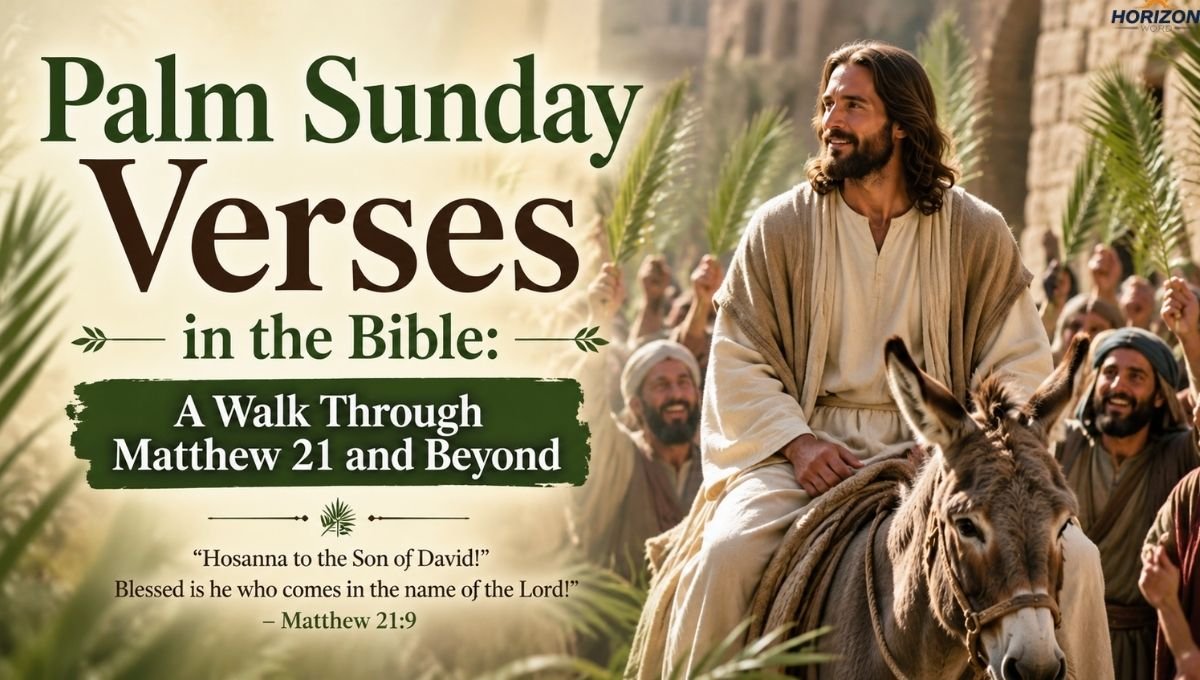
Every spring, Christians around the world celebrate Palm Sunday by waving palm branches and remembering Jesus’ triumphal entry into Jerusalem.
The Palm Sunday verses in the Bible reveal a powerful story of faith, prophecy, humility, and worship.
In this guide, we’ll explore the key Palm Sunday Scriptures, especially Matthew 21, and see what these verses teach us about Jesus and the meaning of Palm Sunday today.
What Is Palm Sunday?
Palm Sunday is the Sunday before Easter, marking the day Jesus rode into Jerusalem on a donkey while crowds waved palm branches and shouted “Hosanna.” It opens Holy Week, the final stretch of days leading to the crucifixion and resurrection.
The event is recorded in all four Gospels Matthew 21:1–11, Mark 11:1–11, Luke 19:28–44, and John 12:12–19 which is itself notable.
Very few moments in Jesus’ ministry are described by every Gospel writer, and that repetition signals just how important the early church considered this day to be.
The name “Palm Sunday” comes from John’s Gospel, which specifically mentions palm branches.
The crowd laid these branches, along with their cloaks, on the road as a way of honoring Jesus as a king entering His city.
Most Powerful Palm Sunday Bible Verses to Read
If you only have a few minutes, these are the Palm Sunday verses in the Bible worth reading first:
- Matthew 21:9 Hosanna to the Son of David! Blessed is he who comes in the name of the Lord! Hosanna in the highest heaven!”
- Zechariah 9:9 “Rejoice greatly, Daughter Zion! Shout, Daughter Jerusalem! See, your king comes to you, righteous and victorious, lowly and riding on a donkey.”
- Mark 11:9–10 the crowd’s cry that “the coming kingdom of our father David” was near.
- Luke 19:38 “Blessed is the king who comes in the name of the Lord! Peace in heaven and glory in the highest!”
- John 12:13 the crowd taking branches of palm trees and going out to meet Him.
Each of these verses captures a different angle of the same moment: a crowd recognizing, at least in part, that something extraordinary was unfolding in front of them.
Palm Sunday Scriptures About Jesus as King
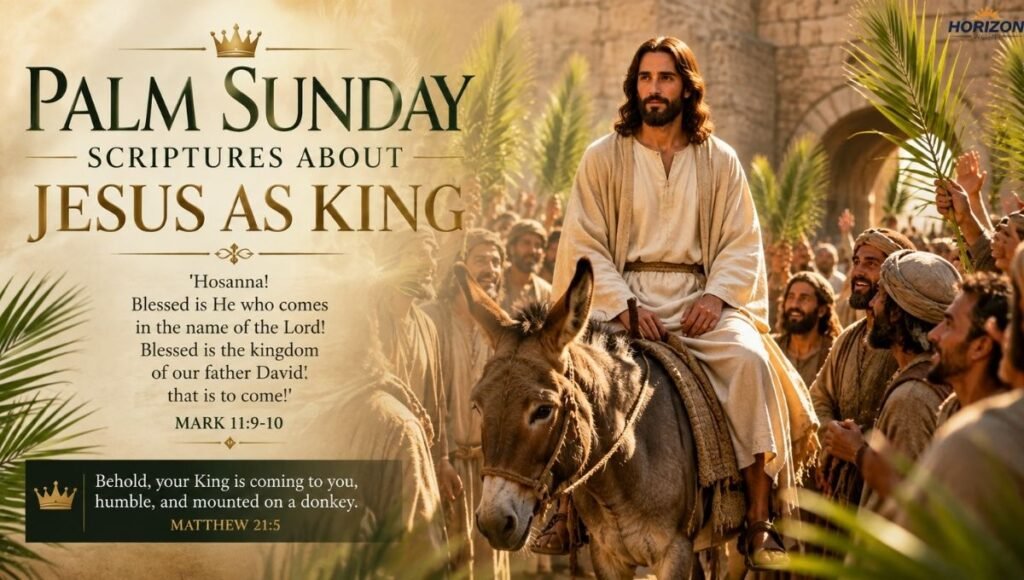
One theme runs through every Palm Sunday account: kingship. The crowd wasn’t simply cheering for a popular teacher.
They were welcoming someone they believed could be the long-promised king of Israel.
This is why the donkey matters so much. Zechariah 9:9, written centuries earlier, described a coming king who would arrive “humble and mounted on a donkey” rather than a warhorse. Matthew draws a direct line to this prophecy in Matthew 21:4–5, telling readers that Jesus’ choice of a donkey wasn’t random it was a deliberate fulfillment of what had already been written.
That detail reframes the whole scene. Jesus wasn’t avoiding the title of king. He was stepping into it, but on His own terms not as a military conqueror, but as a king who comes in peace.
The crowd’s shout of “Hosanna,” which literally means “save us” or “save now,” was both praise and a plea.
They were declaring Jesus as royalty while also asking Him to rescue them, even if their idea of rescue didn’t fully match what Jesus had actually come to do.
Don’t Miss: 120+ Good Evening Blessings: Messages, Quotes, and Prayers
Lessons of Faith and Hope From Palm Sunday
Palm Sunday isn’t just history it carries lessons that still apply to everyday faith.
- Worship can be public and unashamed. The crowd didn’t quietly acknowledge Jesus; they shouted, waved branches, and spread their cloaks in the road.
- Expectations don’t always match reality. Many in the crowd expected a political liberator. Jesus came for something far greater, and far more costly.
- Humility and authority can exist together. A king on a donkey, not a warhorse, still communicated real power.
- Hope often shows up before understanding does. The crowd praised Jesus without fully grasping what would happen just days later.
These themes make Palm Sunday verses in the Bible more than a historical footnote. They offer a mirror for examining our own expectations of God and how we respond when He doesn’t fit the mold we’ve built for Him.
The Key Palm Sunday Passage: Matthew 21:1–11
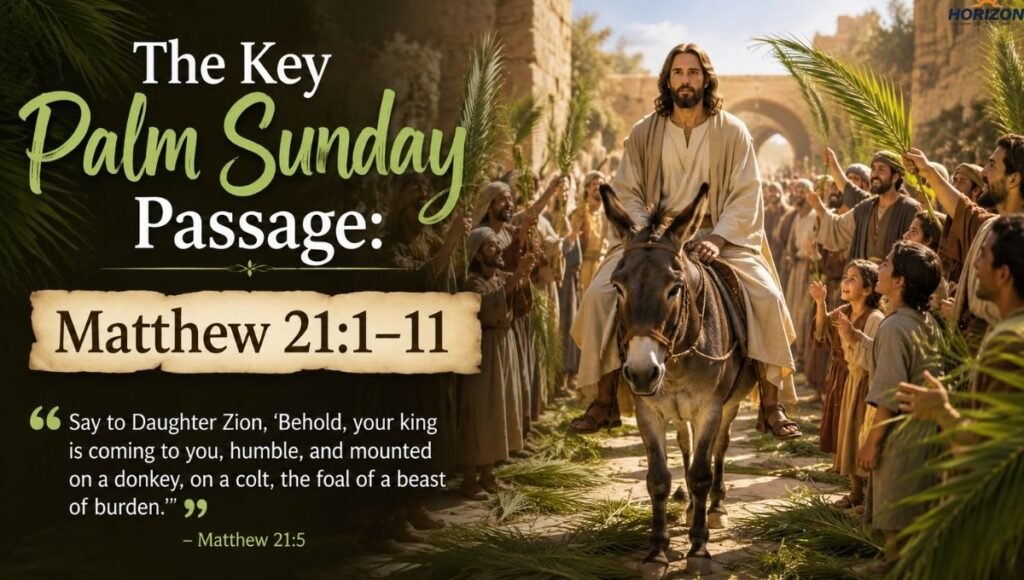
Matthew’s account is the most detailed of the four Gospels and is usually the first passage people turn to when studying Palm Sunday verses in the Bible.
The chapter opens with Jesus and His disciples approaching Bethphage, near the Mount of Olives.
Jesus sends two disciples ahead with specific instructions: find a donkey and a colt, and if anyone questions them, simply say, “The Lord needs them.”
Interestingly, Matthew is the only Gospel that mentions both a donkey and a colt, likely emphasizing the fulfillment of the prophecy in Zechariah 9:9, which references both animals in Hebrew poetic parallelism.
As Jesus rides into the city, the crowd spreads cloaks and branches on the road an ancient gesture of honor typically reserved for royalty.
Their shouts of “Hosanna to the Son of David” identify Jesus with the messianic hope tied to King David’s line.
Matthew 21:10 notes that “the whole city was stirred,” with people asking, “Who is this?” The crowd’s answer “This is the prophet Jesus, from Nazareth in Galilee” shows a partial understanding.
They recognized Jesus as significant, even prophetic, but the fuller truth of who He was would only become clear in the days that followed.
Palm Sunday Verses Across the Four Gospels
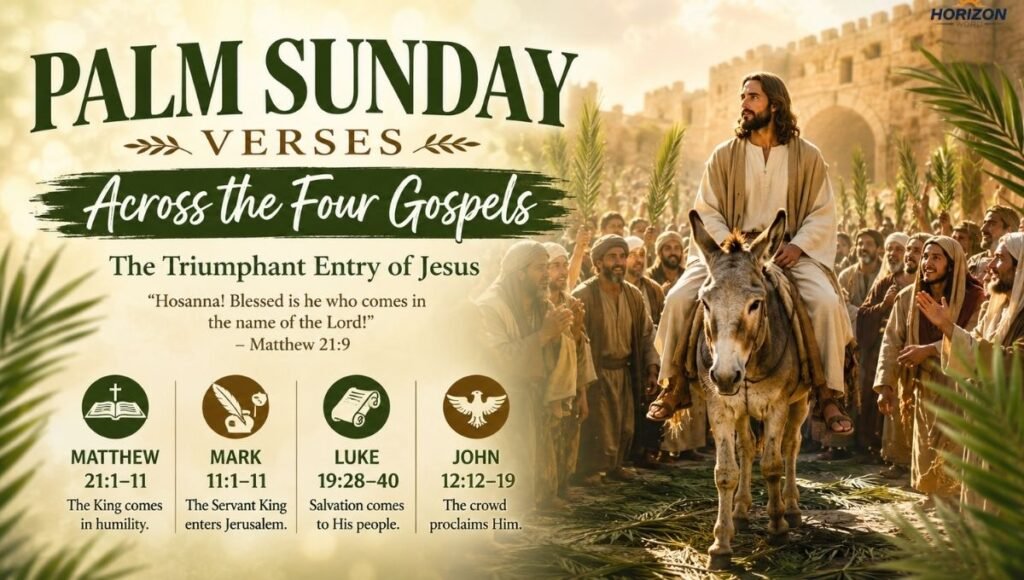
While Matthew offers the fullest narrative, each Gospel adds its own detail, and reading them together gives a richer picture.
| Gospel | Reference | Unique Detail |
| Matthew | 21:1–11 | Mentions both a donkey and a colt; ties the moment directly to Zechariah’s prophecy |
| Mark | 11:1–11 | Notes the colt “had never been ridden”; ends with Jesus quietly entering the temple |
| Luke | 19:28–44 | Includes Jesus weeping over Jerusalem, foreseeing its coming destruction |
| John | 12:12–19 | Explains the crowd came out partly because Jesus had raised Lazarus from the dead |
Luke’s version is especially striking. Just after the celebration, Luke 19:41–42 shows Jesus in tears, saying that if only Jerusalem knew what would bring it peace.
Joy and sorrow sit side by side in the same afternoon a detail easy to miss if you only read Matthew’s account.
John’s Gospel adds context the other writers leave out: the crowd’s excitement was fueled by news of Lazarus being raised from the dead, which had spread quickly through Jerusalem before Jesus even arrived.
Why Palm Sunday Still Speaks Today
It would be easy to read these Palm Sunday verses in the Bible as a nice story about palm branches and move on. But the deeper message is about who Jesus is and how people respond to Him.
The same crowd that shouted “Hosanna” on Sunday would, within days, either fall silent or join calls for His crucifixion.
That shift is uncomfortable, but it’s honest about how quickly enthusiasm can fade when faith gets costly.
Palm Sunday challenges readers to ask a simple question: do we welcome Jesus on our own terms, or on His?
The crowd wanted a king who would fix their immediate circumstances. What they received was a king who dealt with something far deeper sin, death, and the need for a Savior rather than just a ruler.
Prepare Your Heart for the Rest of Holy Week
Palm Sunday is the doorway into Holy Week, not the destination. The same Gospels that record the triumphal entry go on to describe the Last Supper, the arrest in Gethsemane, the crucifixion, and finally the resurrection.
Reading Palm Sunday verses in the Bible alongside the events that follow gives the celebration its full weight.
The shouts of “Hosanna” only make complete sense in light of what Jesus was walking toward a cross, and then an empty tomb.
As Holy Week unfolds, it can be meaningful to slow down and read each Gospel’s account in sequence, letting the story build day by day rather than jumping straight to Easter morning.
Frequently Asked Questions
What is the main Bible verse for Palm Sunday?
Matthew 21:1–11 is considered the primary Palm Sunday passage, describing Jesus’ entry into Jerusalem on a donkey.
What does “Hosanna” mean in the Palm Sunday story?
“Hosanna” means “save us” or “save now,” combining praise for Jesus with a plea for deliverance.
Which Gospels record the Palm Sunday story?
All four Gospels record it: Matthew 21:1–11, Mark 11:1–11, Luke 19:28–44, and John 12:12–19.
Why did Jesus ride a donkey on Palm Sunday?
Riding a donkey fulfilled the prophecy in Zechariah 9:9, symbolizing a humble king who comes in peace rather than conquest.
What Old Testament verse predicted Palm Sunday?
Zechariah 9:9 predicted a king arriving “humble and mounted on a donkey,” which the Gospel writers connect directly to Jesus’ entry into Jerusalem.
What is the difference between Palm Sunday and Passion Sunday?
The terms are often used interchangeably, though “Passion Sunday” sometimes emphasizes readings about Jesus’ suffering, while “Palm Sunday” highlights the triumphal entry itself.
Conclusion
The Palm Sunday verses in the Bible tell a story that’s far richer than palm branches and a parade.
They reveal a king who chose humility over spectacle, fulfilled prophecy written centuries before, and walked knowingly toward the cross even as crowds cheered His arrival.
Reading Matthew 21, alongside Mark, Luke, and John, offers a fuller picture of that first Palm Sunday one filled with hope, misunderstanding, sorrow, and ultimately, purpose.
As Holy Week begins, these verses invite a simple response: not just celebration, but genuine reflection on who Jesus is and why He came.

Ghulam Mustafa | Founder of HorizonWord.com
Christian author and Bible content researcher with 7+ years of experience. Creating biblical name meanings, Scripture-based insights, Bible verses, and faith-filled prayers to help readers grow in faith and connect with God’s Word.







1 thought on “Palm Sunday Verses in the Bible: A Walk Through Matthew 21 and Beyond”