Mazikeen is not mentioned in the Bible, and there is no Mazikeen in the Bible verse that identifies her as a demon or spiritual being. The Old Testament and New Testament do not name a figure called Mackenzie. Instead, the name is associated with the Hebrew term mazziqim, referring in Jewish tradition to harmful or destructive spirits.
Many people search for the meaning of Mazikeen in the Bible, Mazikeen origin, and what kind of demon is Mazikeen in the Bible because of her popular portrayal in Lucifer and The Sandman. However, the fictional character is different from the spiritual beings described in biblical and Jewish traditions.
In this article, we explore Mazikeen mythology, the origin of the name Mazikeen, whether Mazikeen is a real demon, and the closest biblical parallels. We will also distinguish between biblical teaching, Jewish folklore, Islamic references, and modern fictional portrayals of Mazikeen.
Mazikeen Mythology
In mythology and folklore, the name points to a class of beings rather than one individual. Jewish tradition describes mazzikim (also spelled mazikin) as destructive or troublesome spirits that lurk in ruins, deserted places, and darkness.
The named individual Mazikeen is a creation of modern fiction. She was introduced in Neil Gaiman’s The Sandman and later developed in Mike Carey’s Lucifer comics. She is also a main character in the TV series Lucifer. Writers borrowed an old word for demons and gave it a face and a personality.
Mazikeen Origin
Understanding the Origin of the Name Mazikeen
The name comes from the Hebrew root n-z-q, meaning “to harm” or “to damage.” Mazzikim literally means “those who cause harm.” In Jewish folklore, they were seen as invisible nuisances: spirits that could spoil milk, break vessels, or frighten travelers.
Mazikeen is an English-friendly version of that word. Fiction turned a plural noun into a personal name.
Cultural and Spiritual Significance of the Name Mazikeen
In traditional Jewish thought, mazzikim were an everyday explanation for misfortune, not rulers of hell. Naming a character Mazikeen signals an outsider connected to the shadow side of creation. That gives her a built-in mythic weight even though the character is invented.
Meaning of Mazikeen in the Bible
The Bible itself does not use the word mazzikim for demons, and it does not contain the name Mazikeen. The usual meaning attached to it, “harmful spirits,” comes from later rabbinic literature.
So the honest answer is that the meaning of Mazikeen comes from Jewish tradition and folklore, not from scripture.
Don’t Miss:Happy Birthday to Man of God 90+ Wishes & Prayers
Story of Mazikeen in the Bible
There is no story of Mazikeen in the Bible. Any biblical “story” you see online is usually one of three things:
- A retelling of the fictional character’s plot
- A blend of Lilith legends with scriptural passages
- A mix-up with demon-related verses that never mention her
In the stories that do exist, she is a demon warrior from Hell who becomes Lucifer’s loyal companion. That narrative is modern fiction, not scripture.
Mazikeen in the Bible Verse
No verse contains her name. Passages people sometimes connect to her are about related spirit-beings:
- Leviticus 17:7 and Deuteronomy 32:17 mention sacrifices to “devils” (Hebrew se’irim and shedim).
- Isaiah 34:14 names a creature associated with desolate places, which some scholars link to Lilith.
- Leviticus 16 mentions Azazel in the Day of Atonement ritual.
None of these describes a character called Mazikeen.
Mazikeen in the Bible KJV
Searching the King James Version for “Mazikeen” returns nothing. The KJV translates the relevant Hebrew words in ways that hide the underlying terms. Shedim and se’irim appear as “devils,” and the creature in Isaiah 34:14 is rendered as “screech owl.”
That is why people searching KJV text for demons often land on these verses without finding any proper name that matches.
What Kind of Demon Is Mazikeen in the Bible?
Direct answer: She is not a demon in the Bible. In fiction, she is a Lilim, a demon race descended from Lilith in the Lucifer universe. Her closest biblical and Jewish parallels are the mazzikim and shedim.
Closest Biblical Parallels
- Se’irim: “hairy” or goat-like spirits tied to desolate places.
- Shedim: spirits to whom sacrifices were wrongly offered.
- Lilith (Isaiah 34:14): a night creature, though the passage is debated.
- Azazel: a figure connected to wilderness and atonement.
None is a perfect match, which is why Mazikeen reads as a blend of folklore and imagination.
Is Mazikeen a Real Demon?
No evidence supports Mazikeen as a real, named demon in any scripture. The word describes a category of spirits in Jewish folk belief, while the character is a creative invention. Treating her as a historical figure is a common misunderstanding.
What the Talmud Says
The Talmud does discuss mazzikin. In Berakhot 6a, the rabbis say harmful spirits are extremely numerous and that people would be overwhelmed if they could see them. The text treats them as an unseen background danger and does not name a leader called Mazikeen.
Mazikeen in Islam
Mazikeen does not appear in the Quran or in standard Islamic teaching. Islam describes the jinn, beings created from smokeless fire, and the shayatin (devils). These categories overlap loosely with demonic spirits elsewhere, but no Islamic source uses Mazikeen as a name or title.
Mazikeen of Lilith
Lilith is the name most closely tied to Mazikeen in fiction. In later Jewish folklore, Lilith became a figure often described as Adam’s first partner and as a night demon. Stories about her appear mostly in medieval texts, not in the Bible.
In the Lucifer universe, Lilith is a primordial demon and Mazikeen belongs to her lineage, the Lilim. Mazikeen is therefore Lilith-adjacent by design, not by scripture.
Who is the Father of Mazikeen?
No biblical father exists because there is no biblical Mazikeen. In the fictional world, her origins point to Lilith and the Lilim rather than to a human or angelic father. Details differ between the comics and the TV series, so the answer depends on which version you mean.
Her Relationship with Lucifer
Her bond with Lucifer is the center of her story. It combines service, friendship, and tension.
Loyal Demon
Mazikeen follows Lucifer out of Hell and protects him fiercely. Her loyalty is personal rather than blind, and it is repeatedly tested.
Strong and Independent Woman
She is a skilled fighter who also pursues her own goals. Much of her arc is about wanting an identity beyond being someone’s servant.
Complexities of Existence
As a demon who wants more than her assigned role, she struggles with belonging, purpose, and what it means to choose a path. That tension gives the character emotional depth.
Mazikeen Demon Face
Mazikeen is known for having two faces: a human appearance and a demonic one. In the comics, her face is visibly ruined on one side. In the TV series, her demonic face is a frightening visage she usually keeps hidden. The contrast works as a symbol of the gap between how a person appears and what they carry inside.
What Happened to Mazikeen’s Face?
In the comics, her facial damage is part of her backstory and is tied to her violent past in Hell. In the series, the demonic face is her natural form rather than an injury. The explanation differs by adaptation, so it helps to check which version you are following.
Who is Mazikeen in Sandman?
In The Sandman comics, Mazikeen first appears as a companion to Lucifer, a demon who serves as his enforcer and confidante. She later became a major figure in the spin-off Lucifer by Mike Carey. Her role in Gaiman’s world is smaller but sets up her later development.
The Bigger Picture: Mazikeen’s Cultural Impact
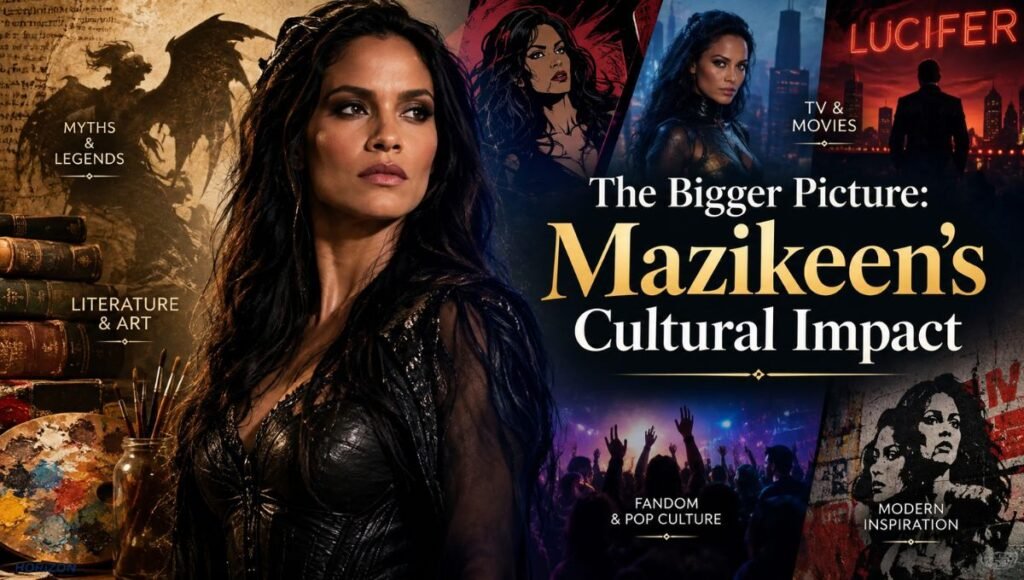
Mazikeen shows how ancient words get reborn as modern characters. A term for harmful spirits in rabbinic writing became one of the best-known female demon characters in popular fiction.
Why She Resonates
- She is loyal without being passive.
- She is dangerous but emotionally honest.
- She wants freedom and belonging at the same time.
Themes She Embodies
- Identity beyond origins
- Chosen loyalty versus obligation
- The idea that “monstrous” and “good” can overlap
Frequently Asked Questions
Is Mazikeen mentioned in the Bible?
No. The name does not appear in any biblical book, including the KJV.
What does Mazikeen mean?
It comes from the Hebrew mazzikim, meaning “those who cause harm,” a term for harmful spirits in Jewish tradition.
Is Mazikeen the same as Lilith?
No. Lilith is a separate figure of Jewish folklore, while Mazikeen is a fictional demon associated with Lilith’s descendants.
Is Mazikeen real in the Talmud?
The Talmud mentions mazzikin as a general class of harmful spirits, not a single named demon.
Is Mazikeen in Islam?
No. Islamic sources discuss jinn and shayatin, not Mazikeen.
Where did Mazikeen first appear?
She debuted in Neil Gaiman’s The Sandman comics and was later expanded in the Lucifer comics and TV series.
Conclusion
Mazikeen in the Bible is a myth: the name never appears in scripture, and the character comes from modern fiction. What does exist is an older Jewish idea of mazzikim, harmful spirits discussed in the Talmud and folklore, along with scriptural passages about related beings.
If you are trying to separate fact from fiction, remember that the biblical parallels are loose and the character is a creative blend. Understanding that distinction lets you enjoy her story while knowing exactly where the real history ends.

Ghulam Mustafa | Founder of HorizonWord.com
Christian author and Bible content researcher with 7+ years of experience. Creating biblical name meanings, Scripture-based insights, Bible verses, and faith-filled prayers to help readers grow in faith and connect with God’s Word.










1 thought on “Who is Mazikeen in the Bible? What Kind of Demon Is She?”