If you’re searching for the Tristan meaning In Bible, you may wonder whether this popular name has a biblical origin or a deeper spiritual connection.
While Tristan does not appear in the Old or New Testament and has no direct Hebrew or Greek roots, its history and meaning still offer interesting insights for Christian families.
Is Tristan a Biblical Name?
No,Tristan is not found anywhere in the Bible. It doesn’t belong to a prophet, apostle, king, or any other figure in scripture.
Instead, Tristan comes from medieval European legend, specifically the Arthurian tale of Tristan and Iseult,
A tragic romance that predates most modern name-meaning trends by centuries. Its roots trace back further still, to old Celtic and Pictish naming traditions.
So while people often search “Tristan meaning in Bible” hoping for a scriptural tie, the honest answer is that its significance comes from literature and language history, not scripture.
What Does Tristan Actually Mean?
Tristan’s meaning has two intertwined threads:
- Celtic/Welsh root: Likely derived from the Pictish name Drustan, a diminutive of Drust, meaning “noise,” “tumult,” or “riot.” Some interpretations lean toward “bold” or “clamor.”
- French influence: As the name traveled into medieval French literature, it became linked by folk etymology to the Old French word triste, meaning “sad” or “sorrowful.”
That second meaning stuck because of the story itself Tristan and Iseult is a tale of forbidden love and tragedy, which cemented the “sorrowful” association for generations.
So today, Tristan is most commonly translated as “sorrowful,” “sad,” or, in its older Celtic sense, “tumult” or “bold noise.”
What Is the Tristan Meaning in Bible Symbolism?
Since Tristan has no direct scriptural reference, any “Tristan meaning in Bible symbolism” is really about interpretation rather than a literal biblical definition.
Christian parents who love the name often connect its themes to spiritual ideas rather than a verse or character:
- Sorrow transformed into purpose echoing biblical themes of turning grief into growth (as in Psalm 30:5, which speaks of joy coming after mourning).
- Boldness and voice tying the “tumult” or “noise” root to the idea of speaking up boldly for one’s faith.
- Loyalty and sacrifice drawing from Tristan’s legendary devotion, which some parents liken to biblical loyalty, such as Ruth’s devotion to Naomi.
These are symbolic, personal interpretations rather than established doctrine, but they’re a meaningful way many families connect the name to their faith.
Don’t Miss: The Amazing Biblical Meaning of the Name Alyssa
Does Tristan Have Hebrew or Greek Roots?
No. Tristan has no Hebrew or Greek origin. It’s rooted in Celtic (Pictish/Welsh) and later French language traditions, not the ancient languages of scripture.
This is an important distinction, because many biblical names (like Daniel, Hebrew for “God is my judge,” or Peter, Greek for “rock”) carry meanings drawn directly from scripture’s original languages. Tristan simply doesn’t share that lineage.
Tristan Name Origin, History, and Cultural Significance
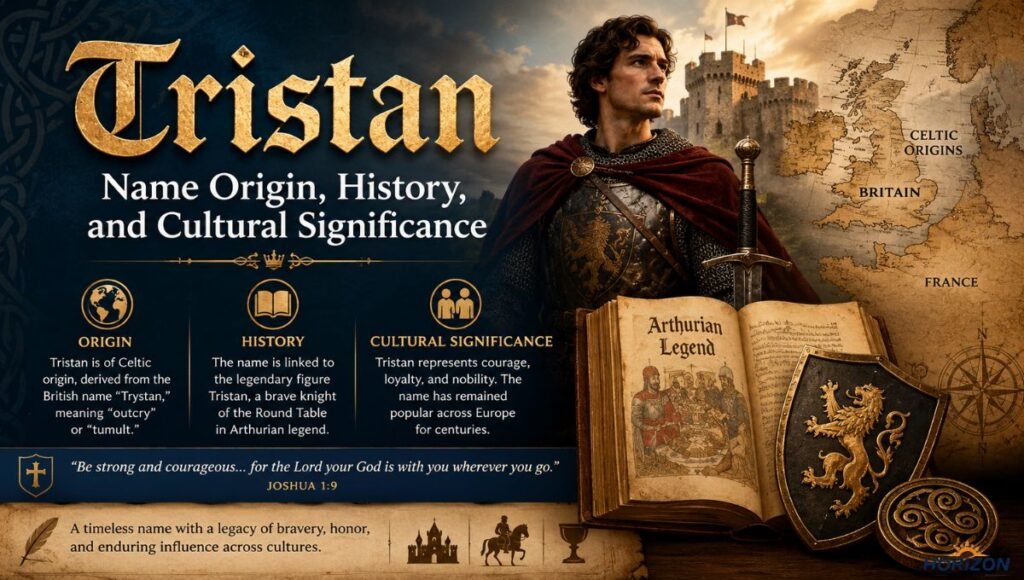
Tristan’s story begins in Celtic Britain and Brittany, where names built on the root drest or drust (“tumult,” “riot”) were common among Pictish and Brythonic peoples.
The name entered wider European culture through the legend of Tristan and Iseult, a Cornish knight who falls in love with an Irish princess after they mistakenly drink a love potion.
The tale spread through French, German, and later English literature, eventually inspiring Richard Wagner’s opera Tristan und Isolde in 1859.
In the United States, Tristan didn’t become common until the late 20th century. It entered the SSA Top 1000 in the early 1970s, climbed steadily through the 1990s, and remains a popular choice today, currently sitting in the top 300 boys’ names nationally.
Spiritual Meaning and Christian Interpretation of Tristan
While Tristan isn’t a scriptural name, many Christian families find spiritual meaning in it by focusing on character rather than etymology.The legendary Tristan was known for:
- Courage in the face of danger
- Loyalty, even at great personal cost
- A willingness to endure hardship for love
These qualities align well with Christian values like steadfastness, sacrificial love, and faithfulness which is likely why the name continues to resonate with faith-centered parents despite having no direct biblical origin.
Tristan Name Meaning, Personality, and Faith-Based Significance
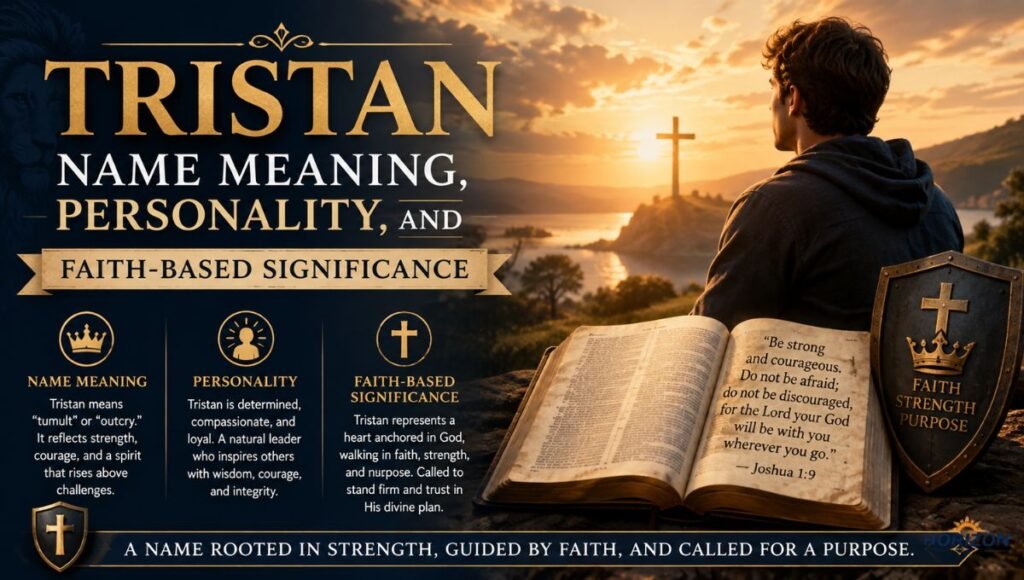
Beyond etymology, many parents are drawn to the personality traits often associated with the name Tristan:
| Trait | Common Association |
| Sensitivity | Reflects the “sorrowful” root, often linked to emotional depth |
| Boldness | Reflects the “tumult/noise” root, linked to confidence and voice |
| Loyalty | Drawn from the Arthurian legend’s central theme |
| Resilience | Associated with overcoming heartbreak in the original tale |
From a faith-based lens, these traits are often reframed as gifts: sensitivity becomes empathy, boldness becomes conviction,
and resilience becomes perseverance through trials themes that appear throughout the Bible even though the name itself does not.
Bible Verses That Reflect Tristan’s Symbolic Meaning
Since Tristan isn’t in scripture, there’s no single “Tristan verse.” Instead, parents often pair the name’s themes with verses that reflect its symbolic meaning:
- On sorrow turning to joy: “Weeping may stay for the night, but rejoicing comes in the morning.” (Psalm 30:5)
- On boldness: “Be strong and courageous. Do not be afraid.” (Joshua 1:9)
- On loyalty: “A friend loves at all times.” (Proverbs 17:17)
These aren’t literal translations of the name they’re thematic pairings some families use when dedicating or blessing a child named Tristan.
Is Tristan a Good Christian or Catholic Name?
Yes, Tristan can absolutely be a good choice for a Christian or Catholic family, even without biblical origin. Plenty of well-loved names in Christian communities including Arthur, Lily, and Grace carry cultural or symbolic rather than strictly scriptural roots.
Since Tristan isn’t officially recognized as a Catholic saint’s name, some Catholic parents choose a biblical or saint’s name as a confirmation or middle name, while keeping Tristan as the given name.
Frequently Asked Questions
Is the name Tristan in the Bible?
No. Tristan does not appear anywhere in the Bible. It originates from Celtic legend and medieval French literature, not scripture.
What is the Tristan meaning in Bible symbolism?
There’s no official biblical symbolism since the name isn’t scriptural. Parents often symbolically connect it to themes like sorrow turning to joy, boldness, or loyalty.
Does Tristan have a Hebrew meaning?
No. Tristan has no Hebrew roots. It comes from Celtic (Pictish/Welsh) origins, later shaped by the Old French word triste, meaning “sad.”
Is Tristan mentioned in any Bible verse?
No, Tristan is not mentioned in any Bible verse. Its associations with biblical themes are symbolic interpretations, not textual references.
Is Tristan a good name for a Christian child?
Yes. While not a biblical name, its themes of loyalty, courage, and resilience align well with Christian values, making it a meaningful choice for many families.
Is Tristen the same as Tristan?
Tristen is simply a modern spelling variant of Tristan. Both share the same Celtic origin and meaning; only the spelling differs.
Conclusion
Tristan isn’t a biblical name, and it carries no Hebrew or Greek roots but that hasn’t stopped it from becoming a name rich in meaning and history.
Rooted in Celtic legend and shaped by centuries of storytelling, it carries themes of sorrow, boldness, and unwavering loyalty.
For Christian families, the appeal often lies less in scripture and more in character: a name that symbolizes resilience and devotion, values that echo biblical teaching even without a direct verse to call its own.

Ghulam Mustafa | Founder of HorizonWord.com
Christian author and Bible content researcher with 7+ years of experience. Creating biblical name meanings, Scripture-based insights, Bible verses, and faith-filled prayers to help readers grow in faith and connect with God’s Word.